


You can read below, or enjoy the audio experience for this post!
Somewhere between late December 2025 and “How is it already February?”…
I realized something.
I didn’t make a New Year’s resolution to watch 150 kung fu movies.
I had already started. It’s like I felt called to return to something I loved watching when I was a kid. I was scrolling through Prime and The Invincible Armour was suggested, and I decided to rewatch it, remembering just how cool the movie was. By the way, for those of you that have watched the Kill Bill movies, Tarantino pulls from this film as well as a few other Shaw Brothers films.
What began as casually rewatching a few classics turned into a full blown immersion. Shaw Brothers logos and beats. Golden Harvest fanfare. Bad dubbing. Flying wirework. Villains with eyebrows sharp enough to cut glass.
Before I knew it, I was deep into a kung fu marathon…
And after binge-watching and rewatching more 70s and 80s martial arts films than any responsible adult with a mortgage probably should…
I learned some things. Or at least re-learned them.
Not just about kung fu.
About life.
Now, let’s be clear. I grew up on this stuff.
Late night Channel 4. “Kung Fu Theater.”
Grainy prints. Ninja shadows on the wall.
Three channels and pure imagination doing the heavy lifting.
These movies weren’t just a past-time for me. They were mythology.
So here’s what they taught me.
Lesson 1 – Simplicity Is Powerful
Kung fu movies don’t overcomplicate things.
There’s a hero.
There’s a code.
There’s a villain who broke it.
Justice will be delivered.
Once it’s delivered, end of movie!
I mean it. A lot of these films just end… on the final kick. It’s funny. It’s crazy.
And I think the point is that good has triumphed, so get on with your life.
When I rewatched Five Deadly Venoms, which was playground legend by the way. It has masked warriors; Centipede, Snake, Scorpion, Lizard, and Toad. It hit me how elegant the storytelling is.
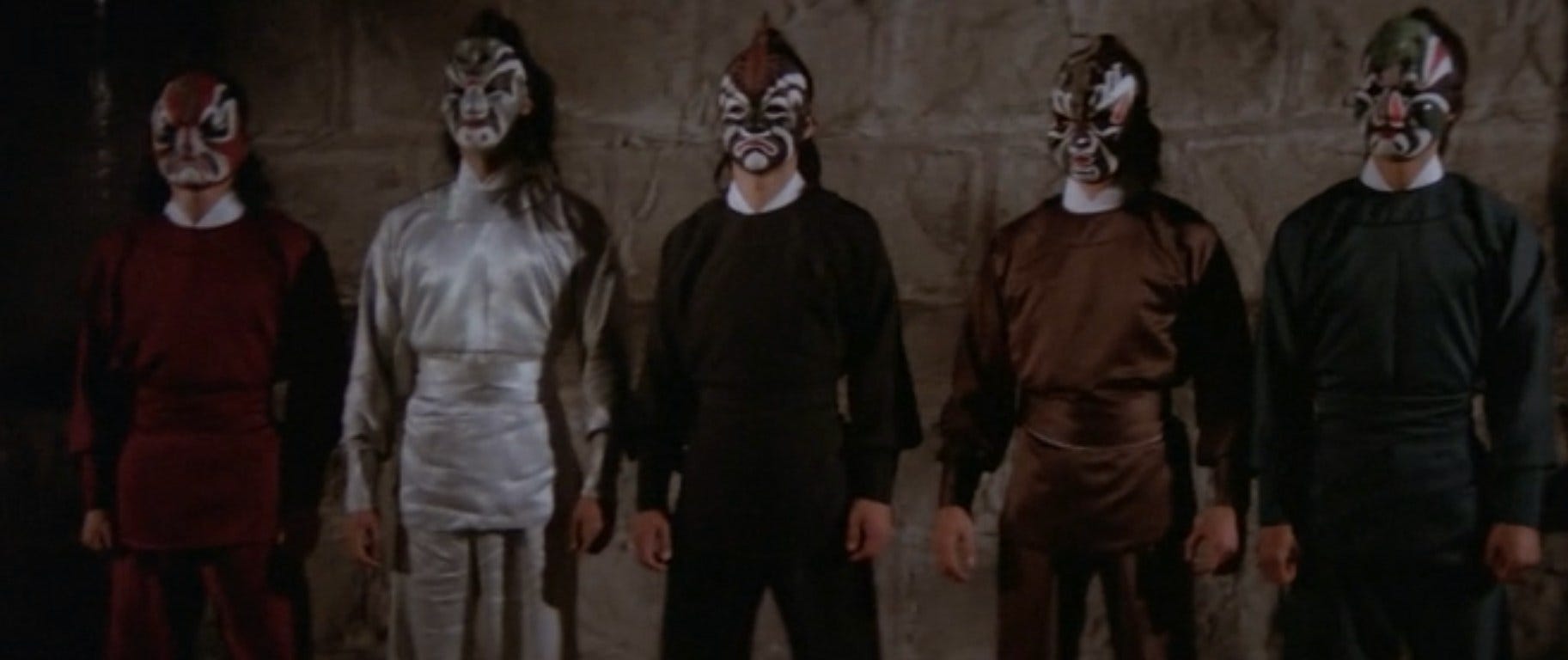
Clear archetypes. Clear stakes.
No cinematic universe homework. (Although kung fu aficionados have a name for the Deadly Venom actors appearing in many films together. It’s referred to the “Venom Mob” phenomenon. But I digress.)
No twist for the sake of twisting.
Just moral clarity wrapped in choreography.
Modern storytelling sometimes feels like it’s afraid of simplicity.
These films weren’t.
And that confidence to tell a simple story that builds and builds? It still works.
But simplicity alone doesn’t carry a film.
You need transformation.
Which brings me to the second lesson.
Lesson 2 – Discipline Beats Talent
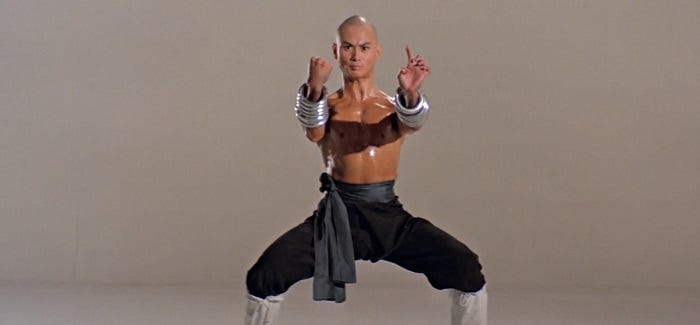
Rewatching The 36th Chamber of Shaolin as an adult hit differently.
As a kid, I loved the training sequences. The water buckets. The bell. The swinging logs.
As an adult?
I saw the philosophy.
That entire movie is incremental growth.
Chamber by chamber.
Failure. Adjustment. Endurance.
No shortcuts.
No montage magic.
Just repetition.
It’s basically a two hour meditation on delayed gratification disguised as kung fu cinema.
And at this stage of life?
That lesson lands harder than any flying kick.
Now let’s talk about legends.
Because you can’t binge this genre without noticing something else.
You’re watching culture shift in real time.
Lesson 3 – Legends Reshape Culture
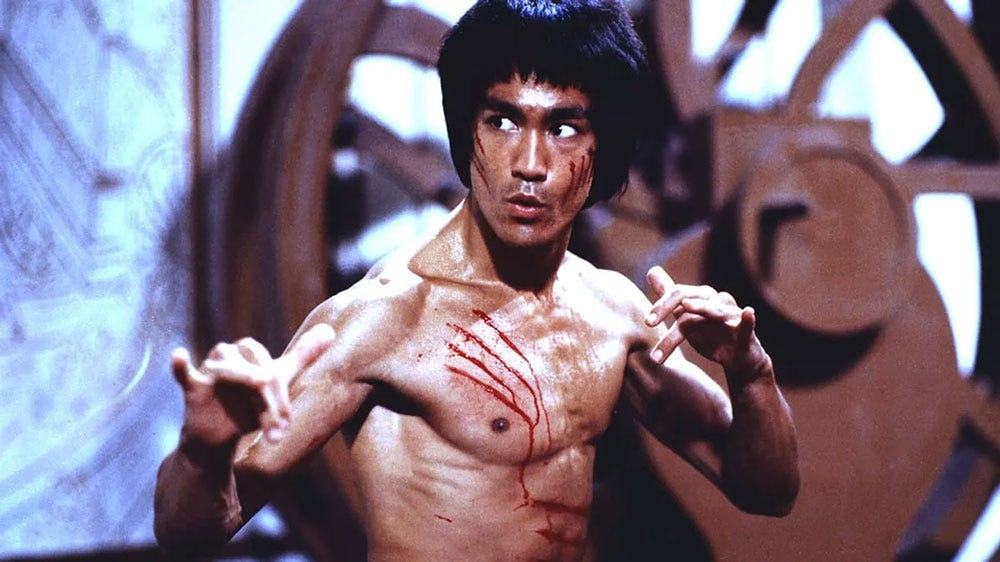
Watching Bruce Lee again is anthropology.
Enter the Dragon still radiates presence. Bruce Lee occupied space differently. He carried philosophy in his posture.
Each of his films has a type of villain and various types of hench men. There’s a love interest in most, but not all. Serving justice is greater than personal ambition or comfort.
Then you watch Jackie Chan come in and flip the tone entirely.
Drunken Master, Police Story, Project A. Suddenly the genre breathes differently.
Bruce made martial arts mythic.
Jackie made it funny and acrobatic.
He stumbled. He improvised. He weaponized ladders.
There was a week where I watched a Bruce Lee film and then a Jackie Chan film, and kept repeating. Watching these films back-to-back, you can literally see the genre evolve. You’re watching tectonic plates move.
That’s what binge-watching does. It reveals patterns.
And here’s something else I didn’t expect.
The “flaws” didn’t bother me.
They became part of the charm.
Lesson 4 – Imperfection Has Texture
The film grain.
The obvious wires.
The hilariously fake beards.
As a kid, I didn’t care.
As an adult? I appreciate them more.
Those imperfections are fingerprints of a filmmaking ecosystem. Shaw Brothers studios weren’t trying to polish things to a Marvel level gloss. They used what they had available.
They were making art at speed. With choreography. With sweat.
Most modern films are immaculate.
But sometimes immaculate feels sterile.
Kung fu movies have texture.
And texture feels human.
And then there’s this:
I expected nostalgia.
I didn’t expect joy.
Lesson 5 – Joy Doesn’t Expire
I still leaned forward a little during final fights. Have you watched the final fight between Jackie Chan and Len Lo in Drunken Master II?!
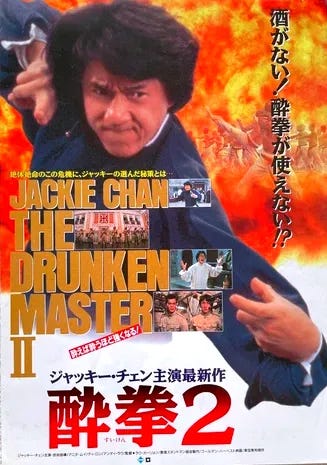
I still laughed at the dubbing.
I still felt that jolt when the villain finally gets what’s coming to him.
There’s a scene in Office Space where Peter (Ron Livingston) awkwardly asks Joanna (played by Jennifer Aniston) if she wants to come over and watch kung fu movies.
When she lights up?
That felt like cultural validation.
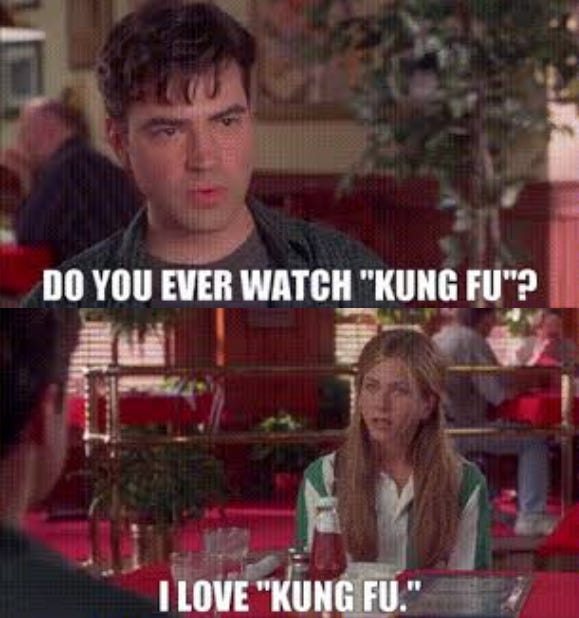
Some of us never stopped loving this stuff.
And that’s okay.
Joy doesn’t age out.
But maybe the biggest lesson wasn’t cinematic.
It was personal.
Lesson 6 – The Kid Is Still In There
I’m not the kid watching Kung Fu Theater after midnight anymore.
I’ve got responsibilities. Deadlines. Expenses that don’t care about Shaolin philosophy.
But give me 90 minutes of flying kicks and temple bells? The kid in me shows up instantly.
Eyes wide. Fully invested.
Binge-watching these films has helped me reconnect with that kid inside. There’s so much crap out there that screws up a potentially great story in modern films, and that’s just not the case with old school kung fu flicks. They tell the damn story, no bs, no politics and agenda. It’s good guy vs bad guy. It’s about growth and getting better… mostly improving your kung fu. And the big take away… Kung Fu is in everything.
And maybe that’s the real training montage.
Not becoming someone new.
Remembering who you were before the world told you to be practical.
So what did I learn from binge-watching kung fu movies?
That simplicity works.
That discipline compounds.
That legends reshape culture.
That imperfection has soul.
And that joy — real joy — doesn’t expire.
I may not hit 150 films exactly on schedule this year. I’ll do my damn best!
Life has a way of kicking you right in the junk even the best plans.
But somewhere between Snake style and Jackie Chan ladder fights…
I found clarity.
And sometimes clarity comes wrapped in grainy film stock and badly dubbed dialogue.
If you’re feeling buried under modern noise, maybe throw on a 70s, 80s, or even 90s kung fu flick.
The kid on the couch might still be waiting.
Alright friends, that wraps up this episode. I hope you enjoyed it. If it resonated with you, share it with someone who grew up on late night Kung Fu Theater or wore out a VHS tape rewinding the final fight scene. And if you just discovered Nostalgia Nation through this episode, make sure you subscribe so you don’t miss what’s coming next.
Until next time, Time Travelers…,
Keep the tape rolling,
And stay rad!


